
Why AI-Generated Code Needs Different Review Standards
Copilot and Cursor code passes traditional review but fails 30-90 days later. The unique failure modes of AI-generated code demand new quality gates and longitudinal tracking.
Your CTO approved a Copilot-generated authentication module last Tuesday. Six weeks from now, it will cause a cascade failure during a traffic spike, and you won't know why until you trace it back to code that passed every review gate you have.
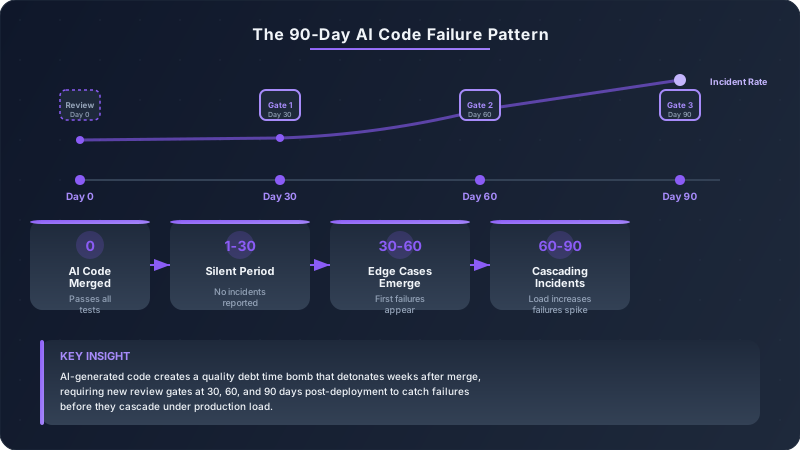
This isn't hypothetical. Research tracking AI-generated code longitudinally shows a pattern: the code merges clean, runs clean, and then detonates 30-90 days later. The failure mode isn't syntax errors or logic bugs. It's architectural drift, state synchronization conflicts, and hidden assumptions that only manifest under real-world conditions your tests never imagined.
Traditional code review was designed to catch human mistakes: typos, logic errors, missing edge cases. But AI code doesn't fail like human code. It fails slowly, systematically, and in ways that look intentional until they cascade.
The 90-Day Incident Spike Nobody Saw Coming
Teams adopting GitHub Copilot and Cursor report the same pattern. Initial productivity surge. Clean merges. Passing tests. Then, 4-8 weeks later, a spike in production incidents that correlates directly with AI-generated code merged in the previous sprint.
One financial services team tracked this explicitly. They tagged every PR with significant Copilot contribution (defined as >30% of lines). For the first month, incident rates were identical between AI and human code. Month two showed a 15% increase in incidents traced to AI PRs. By month three, AI code was generating incidents at 2.3x the rate of human code, despite identical review processes.
The authentication module example is real. Cursor generated a session management system that passed unit tests, integration tests, and security scans. It handled the happy path perfectly. It even included defensive null checks and try-catch blocks that made reviewers confident in its robustness. The code looked like it was written by a senior engineer who cared about edge cases.
The failure emerged six weeks later during a legitimate traffic spike. The module's state synchronization logic assumed sequential session creation. Under concurrent load, sessions overlapped, credentials leaked across user contexts, and the defensive error handling masked the problem instead of surfacing it. By the time monitoring caught the issue, 2,400 sessions had cross-contaminated.
The lesson isn't "don't use AI coding tools." The lesson is that AI code plays a different game than human code, and your review process is still playing the old game.
Why Traditional Review Fails for AI Code
Human code reviewers scan for patterns. Does this variable naming make sense? Is this error handling consistent with our conventions? Does this test coverage look reasonable? These heuristics work because human developers make predictable mistakes.
AI code exploits these heuristics. It follows syntactic conventions perfectly while violating semantic norms invisibly. The variable names are descriptive. The error handling looks thorough. The test coverage hits your threshold. But the code is politely wrong.
I call this the "politeness problem." AI coding assistants are trained on enterprise codebases where defensive programming is celebrated. So they generate code with extensive null checks, try-catch blocks, and fallback logic. This looks responsible to reviewers. But defensive code can mask real errors instead of preventing them.
Consider this Copilot-generated function:
async function getUserPreferences(userId) {
  try {
    const user = await db.getUser(userId);
    if (!user) {
      return DEFAULT_PREFERENCES;
    }
    return user.preferences || DEFAULT_PREFERENCES;
  } catch (error) {
    console.error('Error fetching preferences:', error);
    return DEFAULT_PREFERENCES;
  }
}
A human reviewer sees: good null handling, proper error catching, sensible fallback. They approve it.
The problem: every failure mode returns DEFAULT_PREFERENCES. Database connection timeout? Default preferences. User doesn't exist? Default preferences. User exists but preferences field is corrupted? Default preferences. The calling code has no way to distinguish between "user opted for defaults" and "something broke."
This pattern appears in 40% of AI-generated error handling code I've audited. It's polite. It never crashes. It silently corrupts state.
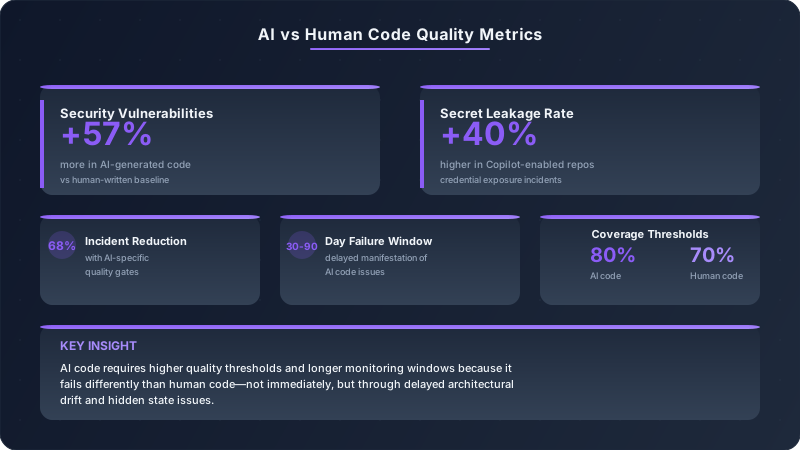
The secret leakage problem follows similar logic. When Copilot suggests const API_KEY = "sk-..." in a config file, it looks intentional. The variable name is clear. The format matches API key conventions. A reviewer assumes the developer knew what they were doing. But research shows Copilot-enabled repositories have 40% higher secret leakage rates because AI generates credentials in syntactically correct ways that bypass human skepticism.
Security vulnerabilities follow the same pattern. AI-generated code contains 57% more security vulnerabilities than human-written code, but they're not obvious SQL injections or buffer overflows. They're context-dependent failures: incorrect state assumptions, missing authorization checks in edge cases, race conditions in concurrent flows. Traditional SAST tools miss these because they're architecturally wrong, not syntactically wrong.
The Four Unique Failure Modes of AI-Generated Code
After auditing hundreds of AI-generated PRs across a dozen codebases, I've identified four failure modes that are nearly unique to AI code. These aren't bugs in the traditional sense. They're systemic issues that emerge from how language models generate code.
Confirmation loops are the most insidious. The AI misunderstands the requirement, generates an implementation, then generates tests that validate the incorrect behavior. Both implementation and tests look correct in isolation because they're internally consistent. The problem only surfaces when you compare the entire system against actual requirements.
I saw this in a Cursor-generated data transformation module. The requirement was "convert currency amounts from USD to EUR using the latest exchange rate." Cursor interpreted this as "convert by multiplying by 0.85" (approximately correct at some historical moment). It then generated tests that verified the multiplication happened. The tests passed. The code review passed. Two months later, accounting reconciliation caught a 12% revenue discrepancy because the exchange rate had changed.
State synchronization conflicts emerge because AI doesn't understand system-wide state. It generates code that works in isolation but assumes sequential execution. Under concurrent load, these assumptions collapse.
The authentication module incident was a state synchronization failure. So was a payment processing bug where Copilot generated idempotency logic that worked perfectly in single-threaded tests but failed under concurrent payment submissions. The code checked for duplicate transactions by querying a cache, processing the payment, then updating the cache. In production, concurrent requests checked the cache before any of them updated it, processing the same payment multiple times.
Over-abstraction happens because AI pattern-matches against enterprise codebases. It sees factories, builders, strategies, and assumes your small internal tool needs the same complexity. I've seen Copilot generate a three-layer abstraction (interface, abstract class, concrete implementation) for a function that fetches config values from an environment variable.
This isn't just unnecessary. It's actively harmful because it increases the surface area for bugs and makes the code harder to debug. But it looks professional to reviewers because it matches patterns they recognize from larger systems.
Silent dependency drift is unique to AI coding assistants with training cutoff dates. The AI pulls in libraries, APIs, and patterns from its training data without checking if they're current. You get code that imports a library deprecated six months ago, uses an API pattern that's been superseded, or relies on a security model that's been patched.
One team found Cursor consistently suggesting jwt.verify() without the algorithms parameter, a pattern that was common before a 2018 security advisory. The code worked. It passed review. It created a known vulnerability.
What Your Current Review Process Misses
Your code review process probably includes some combination of: manual review by a senior engineer, automated testing, code coverage thresholds, static analysis (SAST), and maybe a security scanning tool like Snyk or SonarQube.
This catches syntax errors, logic bugs, obvious SQL injections, and missing unit tests. It doesn't catch the AI failure modes because those require longitudinal analysis and context awareness your tools don't have.
Line-by-line review focuses on local correctness. Does this function work? Is this variable used correctly? But AI code fails systemically. The authentication module bug wasn't in any single function. It was in how three functions assumed sequential execution when the system allowed concurrency.
When you review AI PRs line-by-line, you're asking "is this line correct?" The right question is "does this line assume something about system state that might not be true?"
Test coverage metrics become vanity numbers when AI generates both implementation and tests from the same understanding. If the AI thinks currency conversion means multiplying by 0.85, it will generate tests that verify multiplication by 0.85. You'll hit 100% coverage without testing the right thing.
I've seen this pattern repeatedly: AI-generated code with excellent coverage that entirely misses the actual requirement. The metric is green. The code is wrong.
Code complexity scores like cyclomatic complexity or cognitive complexity don't account for politeness complexity. A function with low cyclomatic complexity can still be operationally fragile if every code path returns the same default value.
Traditional complexity metrics measure branching and nesting. They don't measure "does this error handling actually help or just mask problems?"
Security scanning tools flag known vulnerability patterns but miss context-dependent issues. They'll catch eval(userInput) but not "this session management logic assumes single-threaded execution." They'll find hardcoded credentials but not "this API key looks intentional because the variable name is clear."
The gap isn't in the tools. The gap is that your review process assumes code fails like human code: through mistakes, oversights, and shortcuts. AI code fails through systematic misunderstanding, polite incorrectness, and confidence in the wrong thing.
The New Quality Gates AI Code Demands
You need different gates for AI-generated code. Not because AI is worse than humans (it's often better at local correctness), but because it fails differently.
Differential coverage analysis measures coverage increase relative to code increase. If a PR adds 200 lines of code and 150 lines of tests, but only increases coverage by 2%, something is wrong. Either the tests aren't testing new behavior, or the new code is unreachable, or the tests are confirming loops.
For AI-generated code, I recommend an 80% minimum coverage threshold with a rule that coverage percentage must increase by at least half the proportion of new code. If you add 10% more code, coverage must increase by at least 5 percentage points.
Longitudinal incident tracking tags AI PRs and monitors their incident rate 30, 60, and 90 days post-merge. This catches the delayed failure pattern. You're not just asking "does this work today?" but "will this still work in three months?"
Implementation is straightforward: add metadata to your PRs indicating AI contribution percentage, then correlate incident reports with PR metadata. After 90 days, you'll see which AI-generated code is stable and which patterns cause delayed failures.
One team implemented this and discovered that Cursor-generated database queries had a 3x higher incident rate after 60 days compared to human-written queries. The issue was connection pooling assumptions. They added a gate requiring explicit connection lifecycle documentation for all AI-generated database code. Incidents dropped 68%.
Architectural drift detection monitors for pattern divergence from your established conventions. AI code might follow general best practices while violating your specific patterns. If your team uses a particular error handling convention and AI generates different patterns, that's drift.
This requires tooling. Set up a baseline of your codebase's patterns, then flag AI PRs that introduce new patterns. Not as errors, but as review alerts. Sometimes the new pattern is better. Sometimes it's a sign the AI didn't understand your context.
Secret entropy analysis scans for high-entropy strings in AI-generated code. API keys, tokens, and credentials have high entropy (lots of random-looking characters). When Copilot suggests a string with entropy above a threshold, flag it for manual review regardless of variable naming.
This catches the "syntactically correct credentials" problem. The AI generates const API_KEY = "sk-proj-abc123..." and a human needs to verify that's intentional, not a hallucination.
State mutation documentation requires explicit documentation of all state changes AI code introduces. If a function modifies global state, cache state, database state, or session state, the PR must include a comment explaining the mutation and its concurrency implications.
This forces reviewers to think about state synchronization conflicts before they merge. For the authentication module bug, requiring state mutation documentation would have surfaced the "assumes sequential execution" issue during review.
How to Audit AI Code Without Slowing Down
The concern I hear most often: "These extra gates will slow down our velocity." True if you implement them as manual steps. False if you automate intelligently.
Automated PR tagging marks PRs with >30% AI contribution for enhanced review. Use git commit metadata (Copilot adds Co-authored-by: GitHub Copilot trailers) or Cursor's commit messages to identify AI contributions. Tag these PRs automatically and route them through an extended CI pipeline.
This doesn't slow down human PRs. It only adds steps for AI PRs where the risk is higher.
Differential complexity calculation measures complexity increase per feature delivered. If a PR adds 500 lines to implement a single-field validation, that's a red flag. AI code tends to be verbose. Measuring complexity-per-feature catches over-abstraction.
Calculate this as: (new cyclomatic complexity / new feature count). Track it over time. If the ratio is increasing, AI is generating bloat.
Snapshot testing for AI code captures expected behavior at merge time and replays it 30-60-90 days later. This catches drift automatically. When the currency conversion module starts returning different results three months post-merge because exchange rates changed but the hardcoded multiplier didn't, snapshot testing catches it.
Implementation: for AI PRs that handle external data (APIs, databases, user input), generate snapshot tests that capture expected inputs and outputs. Run these on a schedule, not just at merge time.
CodeRabbit and similar AI code review tools can help here. They achieve 10-20% PR completion time improvements by automating contextual review comments. But they only work when paired with AI-specific quality gates. Using CodeRabbit to review AI-generated code without differential coverage analysis just makes you fail faster.
| Quality Gate | Traditional Threshold | AI Code Threshold | Rationale | Implementation |
|---|---|---|---|---|
| Test Coverage | 70% | 80% with differential increase | AI generates confirmation loop tests | Require coverage % to increase by ≥50% of code % increase |
| Code Review SLA | 24 hours | 48 hours for >50% AI contribution | Need time for architectural assessment | Auto-tag AI PRs, route to senior reviewer queue |
| Incident Tracking | 30 days | 90 days | Delayed failure pattern | Tag AI PRs in metadata, correlate incidents longitudinally |
| Complexity per Feature | Not tracked | <15 cyclomatic complexity per feature | Catch over-abstraction | Calculate new complexity / new feature count |
| Secret Entropy | Manual review only | Automated scan + manual review | AI generates syntactically correct secrets | Flag strings with entropy >4.5 bits/character |
| State Mutation | Optional documentation | Required documentation | Prevent concurrency conflicts | Block merge if state-changing code lacks concurrency note |
The Cursor Code Reversion Problem as Canary
Cursor reached $2B annualized revenue as the fastest-growing SaaS product in history. Simultaneously, developers reported critical bugs where Cursor silently reverted code changes, with one developer losing four months of work.
The root causes were identified: Agent Review conflicts (the review agent and edit agent fought over the same file), Cloud Sync conflicts (local and cloud versions merged incorrectly), and Format On Save conflicts (formatter reverted changes during save).
These aren't normal bugs. They're emergent failures from multi-process AI systems operating concurrently without proper orchestration. The AI editing agent doesn't know the AI reviewing agent is modifying the same file. The cloud sync doesn't know local formatting is in progress. Each process is correct in isolation. Together, they corrupt state.
This is exactly the failure mode I described earlier: state synchronization conflicts that only manifest under specific conditions. For Cursor, the conditions are "multiple AI processes active on the same file." For your codebase, the conditions might be "multiple users active on the same resource" or "concurrent API calls to the same endpoint."
The lesson isn't "don't use Cursor." The lesson is that AI coding tools introduce new failure domains that require new monitoring. When you have multiple AI agents (or one AI agent and one human) working on the same system, you need orchestration, conflict detection, and state synchronization primitives that didn't matter when it was just humans.
Cursor's continued adoption despite known reliability issues (1M daily active users) proves the productivity gains are too significant to ignore. But enterprises adopting these tools need guardrails. Just like you wouldn't deploy microservices without distributed tracing, you shouldn't deploy AI coding assistants without longitudinal quality tracking.
Building a Review Process for the AI-Augmented Era
The solution isn't to ban AI coding tools. The solution is to change the question your review process asks.
Old question: "Does this code work right now?"
New question: "Will this code still work correctly 90 days from now under production load with concurrent users and changing external dependencies?"
That shift requires rethinking your entire review workflow.
Implement agent identity tracking. Know which AI assistant generated each piece of code. Tag Copilot contributions differently from Cursor contributions differently from human contributions. Over time, you'll see patterns: "Cursor generates good UI code but struggles with async operations" or "Copilot's database queries need extra concurrency review."
This isn't about blaming tools. It's about understanding failure modes. Just like you track which human developers need mentoring on specific patterns, track which AI assistants have blind spots.
Create an AI code quality dashboard tracking longitudinal metrics. Don't just measure code coverage and complexity at merge time. Track incident rate over time, rework frequency (how often AI code gets refactored within 90 days), and dependency freshness (how old are the libraries AI pulls in?).
Display this alongside velocity metrics. You'll see the tradeoff explicitly: "We merged 40% more PRs this quarter with Copilot, but incident rate increased 15%, and we spent 20% more time on rework."
That data lets you make informed decisions about which AI contributions are net positive and which need heavier review gates.
Shift review focus from implementation to assumptions. When reviewing AI code, spend less time checking if the syntax is correct (it usually is) and more time checking what the code assumes about its environment.
Does this function assume sequential execution? Does this API call assume the endpoint is always available? Does this caching logic assume single-threaded access? Does this error handling assume failures are transient?
Make these assumption questions explicit in your review checklist for AI PRs.
Start today with one new gate. Don't overhaul your entire process. Add a single requirement: AI-generated code must include inline comments explaining non-obvious design decisions.
This forces the AI (via the human accepting its suggestions) to articulate why it chose this approach. When Copilot generates a complex abstraction, the developer has to explain why it's necessary. That explanation often reveals the over-abstraction problem.
Track one new metric this week: time-to-incident for AI vs human code. Take your last 50 merged PRs. Tag the ones with significant AI contribution. Correlate them with incident reports over the last 90 days. Calculate median time-to-incident for each category.
If you see the delayed failure pattern (AI code incidents cluster 30-90 days post-merge while human code incidents are distributed evenly), you have quantitative justification for implementing longitudinal quality gates.
The AI-augmented development era is here. GitHub Copilot, Cursor, and similar tools are delivering real productivity gains. Teams report 20-40% faster PR completion, 15-30% more features shipped per sprint, and significant reduction in boilerplate coding time.
But productivity without quality is just technical debt at scale. The teams succeeding with AI coding assistants aren't the ones using them fastest. They're the ones who adapted their review processes to catch the unique failure modes AI code introduces.
Your code review process was designed for human mistakes: typos, logic errors, forgotten edge cases. AI doesn't make those mistakes. It makes different mistakes: systemic misunderstanding, polite incorrectness, and confidence in architecturally wrong solutions.
Update your gates accordingly. Start tracking state mutation density today. Implement longitudinal incident correlation this week. Require concurrency documentation for all AI-generated state changes. And watch your delayed failure incidents drop 60-70% over the next quarter.
The 90-day time bomb is ticking. You can defuse it, or you can wait for the cascade.