
Code Governance for Regulated Industries: From Months of Audit Prep to Hours
Automated code governance with merge gates, PR evidence collection, and policy-as-code cuts SOC 2, HIPAA, and FedRAMP audit prep from months to hours while strengthening actual security posture.
It's 4:47 PM on a Thursday. Your SOC 2 Type II audit starts Monday. The compliance lead just pinged the engineering channel asking for evidence that every production change in the last six months had a documented review, an approved reviewer, and a security scan. Your team ships 40 PRs a week across three repositories. That's roughly 1,040 pull requests someone needs to manually verify, screenshot, and organize into a binder that will satisfy an auditor who has never opened a terminal.
You already know the answer before anyone responds: the evidence doesn't exist in any queryable form. Some PRs have reviews. Some were self-merged during an incident. A few bypassed branch protection because someone with admin access pushed a hotfix at 2 AM. The gap between what your security policy PDF says and what your git history actually proves is exactly where audit findings live.
Most engineering teams treat compliance as a documentation exercise, something the security team owns that engineers tolerate twice a year. This creates a dangerous illusion: the policy says one thing, the codebase tells a different story, and the audit binder papers over the difference. The thesis here is simple. Automated code governance makes compliance a side effect of good engineering, not a separate workstream. When your merge gates enforce policy, every merged PR becomes a compliance artifact automatically. You stop building audit binders because the evidence generates itself.
Your Audit Binder Is a Lie
The traditional compliance workflow looks like this: engineers write code, compliance writes policies, and once or twice a year someone spends six to eight weeks manually collecting evidence that the two are connected. This workflow has a fundamental flaw. It assumes the evidence exists to be collected.
In practice, teams discover gaps only during the collection phase. A repository had branch protection disabled for a sprint while debugging CI issues. A contractor merged code without going through the standard review process. A security scanning tool was configured but its results were never gated on, meaning vulnerable code merged while the scan results sat in a dashboard nobody checked.
These aren't hypothetical scenarios. They're the findings that show up in SOC 2 reports, HIPAA risk assessments, and FedRAMP continuous monitoring reviews. The fix isn't better documentation. It's engineering controls that make non-compliant code physically unable to reach production.
What Auditors Actually Look For in Your Codebase
Auditors don't read your code. They read your controls, and then they test whether those controls actually work. Understanding what they test helps you build the right gates.
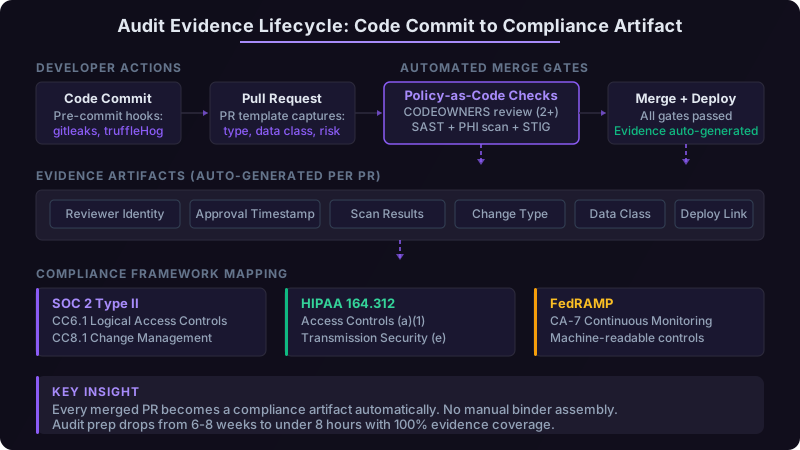
SOC 2 Trust Service Criteria map directly to code review practices. CC6.1 (Logical Access Controls) requires evidence that only authorized individuals can modify production systems. CC8.1 (Change Management) requires that changes are authorized, tested, and approved before deployment [1]. An auditor will sample 25 to 50 changes and look for reviewer identity, approval timestamps, and evidence that security checks ran before the merge. If even one sampled change lacks this trail, you have a finding.
HIPAA Security Rule technical safeguards under 164.312 translate to specific engineering requirements: access controls on systems handling Protected Health Information, audit controls that record who touched what, and transmission security for PHI in transit [2]. For engineering teams, this means merge requirements that verify PHI pattern scanning ran, that database migration PRs involving patient data had security team approval, and that encryption library usage is validated automatically.
FedRAMP continuous monitoring is where most teams fail hardest. The framework requires ongoing evidence of control effectiveness, not quarterly PDF snapshots. FedRAMP's updated requirements expect machine-readable control outputs that can be validated on demand [3]. If your compliance posture is only visible during audit windows, you don't meet the standard.
Common Audit Findings
The findings I see most often trace back to the same root causes:
- Missing approval trails on 10 to 15% of sampled changes, typically hotfixes and "urgent" patches
- Inconsistent review coverage where some repos have strict branch protection and others have none
- No evidence of pre-merge security scanning, even when scanning tools are installed and configured
- Self-merged commits by repository administrators that bypass all controls
Every one of these is preventable with properly configured merge gates.
Merge Gates as Compliance Controls
A merge gate is a programmable policy checkpoint that blocks non-compliant code from reaching a protected branch. Think of it as a bouncer at the door of your production branch: no entry without meeting every requirement on the list.
The specific gates you need depend on your compliance framework:
- SOC 2 (CC8.1): Require at least two approved reviewers from a defined CODEOWNERS group, plus passing status checks from your CI pipeline. This creates an immutable record of who approved each change and when.
- HIPAA (164.312): Add PHI pattern scanning as a required status check. Tools like Nightfall or custom regex checks can scan diffs for Social Security numbers, medical record numbers, and other PHI patterns before code merges.
- FedRAMP (STIG compliance): Include STIG configuration checks and FIPS-validated cryptography verification as merge prerequisites. Every merge produces a machine-readable compliance record.
The power of merge gates is that they produce audit evidence as a byproduct of shipping code. When GitHub's branch protection requires two approving reviews plus passing checks from SonarQube and Snyk before a merge, every merged PR automatically contains reviewer identities, timestamps, scan results, and the approval chain. No manual documentation needed.
A healthcare SaaS team I worked with had recurring SOC 2 findings around change management for three consecutive audit cycles. They implemented three merge gates: mandatory code owner review, required passing security scans, and automated PR labeling that tagged changes touching PHI-adjacent services. The next audit cycle produced zero change management findings. The evidence was already in every merged PR.
| Control Area | Manual Process | Automated Merge Gates | Framework Mapping |
|---|---|---|---|
| Change approval | Screenshot PR approvals into shared drive | Branch protection requires CODEOWNERS review | SOC 2 CC8.1, HIPAA 164.312(a) |
| Security scanning | Run scans weekly, email results | Pre-merge status checks block unscanned code | SOC 2 CC7.1, FedRAMP CA-7 |
| Access control evidence | Export user lists quarterly | Git permissions + CODEOWNERS auto-documented | SOC 2 CC6.1, HIPAA 164.312(a)(1) |
| Secrets detection | Annual credential rotation audit | Pre-commit and pre-merge secret scanning gates | SOC 2 CC6.1, HIPAA 164.312(e) |
| Review coverage | Sample PRs manually during audit prep | 100% coverage enforced, exceptions logged with justification | All frameworks |
Automated PR Evidence Collection That Auditors Love
Every pull request, when structured correctly, is a compliance artifact. It contains the reviewer's identity, a timestamp of when the review happened, the results of every automated check that ran, the approval chain, and (with the right CI/CD setup) a link to the deployment that resulted from the merge.
The problem is that most teams leave this evidence unstructured. Review comments live in GitHub. Scan results live in SonarQube. Deployment records live in ArgoCD or AWS CodeDeploy. When an auditor asks "show me the complete evidence chain for this production change," someone has to manually stitch four systems together.
Structure your PR templates to capture compliance metadata explicitly. Add required fields for change type (feature, bugfix, hotfix, security patch), impacted data classification (public, internal, PHI, PII), and risk tier. This metadata makes your evidence machine-queryable. Instead of searching Confluence pages during audit prep, you run a single API query against your git provider and get a structured dataset of every change, its classification, its reviewers, and its scan results.
Tools like SlopBuster add another layer here. AI-assisted code review generates richer evidence than human-only processes because the review captures specific findings: "flagged potential SQL injection on line 47," "verified encryption library usage matches approved list," "detected hardcoded credential pattern." This specificity is exactly what auditors want to see. The Engineering Intelligence Dashboard from Connectory can then surface compliance posture metrics in real time, so you know your audit readiness at any given moment, not just during prep season.
Policy-as-Code: Writing Rules Machines Can Enforce
Policy-as-code means encoding your compliance requirements as executable checks that run automatically. Instead of a Word document that says "all database queries must be parameterized," you write an OPA/Rego policy, a custom GitHub Action, or a pre-merge hook that detects string-concatenated SQL and blocks the merge.
Here are policies that map directly to compliance controls:
- No secrets in code: A pre-commit hook using gitleaks or truffleHog scans every diff for API keys, connection strings, and credentials. Maps to SOC 2 CC6.1 and HIPAA 164.312(e).
- All database queries parameterized: A custom SAST rule flags raw SQL construction patterns. Maps to SOC 2 CC7.1 and OWASP Top 10 A03.
- PHI fields use approved encryption libraries: A check verifies that any field annotated as PHI uses the organization's approved encryption package, not a random npm library. Maps to HIPAA 164.312(a)(2)(iv).
- No direct production database access in application code: A policy check ensures connection strings reference secret managers, never hardcoded endpoints.
The critical advantage of policy-as-code is drift elimination. Written security policies and actual engineering behavior diverge over time. New developers join who never read the policy document. Teams adopt new frameworks that weren't covered by the original rules. Policy-as-code closes this gap because the policy is the enforcement mechanism. If the check doesn't pass, the code doesn't merge.
This becomes non-optional when you factor in AI-generated code. Research shows that 29.1% of AI-generated Python code contains vulnerabilities including SQL injection risks, XSS vectors, and improper input validation [5]. Developers using Copilot, Cursor, or Claude Code can generate hundreds of lines per hour. Manual review cannot keep pace with that velocity. Policy-as-code is the only mechanism that scales to govern AI-generated output.
The AI-Generated Code Problem Auditors Haven't Caught Yet
Here's what keeps me up at night about compliance in 2025 and 2026: auditors haven't updated their sampling methods for the AI-assisted development era.
AI coding tools generate code faster than teams can review it. A developer using Copilot or Cursor can produce three to five times more code per day than one working unassisted. But the compliance framework still assumes a human wrote the code and another human reviewed it thoughtfully. When AI generates a function that hardcodes a credential, introduces an SQL injection, or uses a deprecated encryption library, the speed advantage becomes a compliance liability.
The numbers are sobering. Research from SecurityScorecard found that repositories with high AI-assisted contribution rates show 40% higher secret leakage rates [5]. This directly violates SOC 2 CC6.1 (logical access controls) and HIPAA encryption requirements under 164.312(e).
Beyond the code itself, shadow agents represent the new shadow IT for regulated industries. Developers install AI coding extensions, configure autonomous agents in their IDEs, and connect them to codebases without going through security review. These tools can access private repositories, read environment variables, and generate code that reaches production without anyone knowing an AI was involved. The EU AI Act, now enforced in 2026, makes undiscovered agents an existential compliance risk, not just a security nuisance [6].
Automated code governance tools like SlopBuster catch what AI generates before it reaches a protected branch. By running security-focused review on every PR, regardless of whether a human or an AI wrote the code, you maintain compliance coverage even as code generation velocity increases. Quality Radar metrics can surface which repositories have the highest AI-generated code ratios and correlate those with vulnerability density, giving security teams visibility into where the risk concentrates.
From Framework to Implementation: A 30-Day Playbook
Stop treating this as a quarterly project. Here's how to get automated code governance running in 30 days.
Week 1: Audit Your Current State
Run this query against your GitHub or GitLab instance: for every merge to your main branch in the last 90 days, can you programmatically retrieve the reviewer(s), approval timestamp, and security scan status? If the answer is no for even 10% of merges, you have a compliance gap. Map your current git configuration against the specific controls for your framework (SOC 2 CC6.1/CC8.1, HIPAA 164.312, or FedRAMP CA-7).
Week 2: Implement Merge Gates
Enable branch protection on every production branch. Configure required reviewers using CODEOWNERS files that map to your organizational access control policy. Add required status checks for your existing CI pipeline, security scanner (Snyk, SonarQube, or Semgrep), and secret detection tool.
Week 3: Deploy Policy-as-Code
Identify your top 10 compliance-critical code patterns and write executable checks for each. Start with secret detection, parameterized queries, and encryption library validation. Deploy these as required status checks that block merges on failure.
Week 4: Connect and Validate
Wire your PR metadata into a queryable evidence repository. This can be as simple as a scheduled GitHub API export to a structured data store. Then run a mock audit: can you answer "who reviewed every production change in the last 90 days, and what security checks passed before merge?" in under 10 minutes? If yes, you're audit-ready. Use the Engineering Intelligence Dashboard to monitor compliance posture continuously rather than checking only during audit windows.
Compliance as a Competitive Advantage, Not a Tax
Teams with automated compliance controls ship faster. This sounds counterintuitive until you realize the bottleneck was never the controls themselves. It was the manual overhead of proving the controls work.
When merge gates enforce policy and every PR generates its own evidence chain, there is no audit prep phase. Your compliance lead doesn't ping the engineering channel in a panic the week before the audit. They open a dashboard, run a query, and export a report. The audit binder from our opening scenario stops being a lie because it stops being a binder. It becomes a live system that reflects reality at every moment, not a reconstructed narrative assembled under deadline pressure.
Here's your concrete next step: open a terminal right now and run a query against your git provider's API to answer one question. "For every merge to our main branch in the last 90 days, do we have a reviewer identity, an approval timestamp, and a passing security scan recorded?" If you can answer that in under five minutes, you're ahead of most regulated engineering teams. If you can't, you know exactly where to start.
The metric to track this week: percentage of production merges with complete automated evidence chains. Measure it today, set a target of 100%, and build the gates that make anything less impossible.
References
[1] AICPA, "SOC 2 Type II Trust Service Criteria," 2017. https://www.aicpa.org/resources/landing/system-and-organization-controls-soc-suite-of-services
[2] U.S. Department of Health and Human Services, "HIPAA Security Rule: Technical Safeguards, 45 CFR 164.312," 2013. https://www.hhs.gov/hipaa/for-professionals/security/laws-regulations/index.html
[3] FedRAMP, "Continuous Monitoring Strategy Guide," 2023. https://www.fedramp.gov/assets/resources/documents/CSP_Continuous_Monitoring_Strategy_Guide.pdf
[4] CyberAB (formerly CMMC Accreditation Body), "CMMC Assessment Process (CAP) Observations," 2024. https://cyberab.org
[5] SecurityScorecard and Orca Security, "AI-Generated Code Security Analysis," 2024. Referenced in multiple analyses including Orca Security blog, "The State of AI-Generated Code Security," 2024. https://orca.security/resources/blog/ai-generated-code-security/
[6] European Commission, "EU Artificial Intelligence Act," 2024. https://artificialintelligenceact.eu/
[7] GitHub, "Octoverse 2024: The State of Open Source and AI," 2024. https://github.blog/news-insights/octoverse/octoverse-2024/
[8] DORA Team, "Accelerate State of DevOps Report," 2024. https://dora.dev/research/