
Engineering Quality Beyond Test Coverage: Metrics That Actually Matter
Test coverage percentage is a poor predictor of production reliability. Here are the leading indicators—Change Failure Rate, Review Depth Score, and rework rate—that actually tell you whether your codebase is healthy.
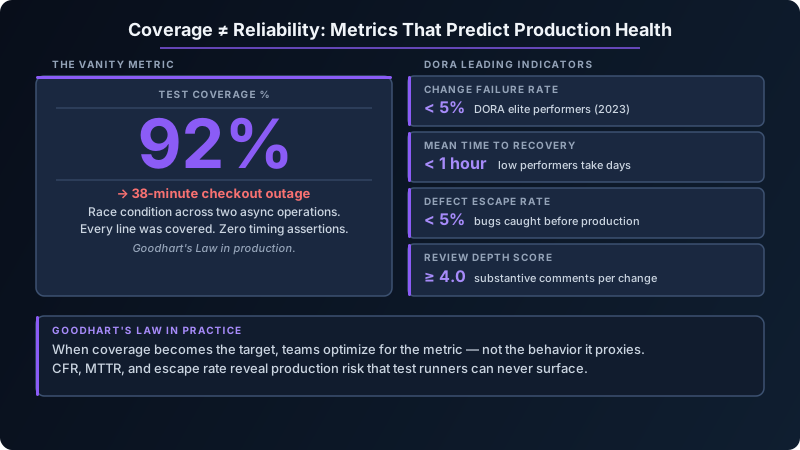
I shipped a microservice last year with 92% line coverage. Six weeks later it caused a 38-minute checkout outage. The race condition that brought it down was completely untested — every line was covered, but the critical timing assumption between two async operations had zero assertions.
Coverage is a proxy. It tells you which lines a test runner touched, not whether your system behaves correctly under real conditions. Yet it remains the dominant metric in most engineering orgs because it's easy to measure, easy to enforce in CI, and easy to show on a dashboard.
Goodhart's Law applies directly here: when a measure becomes a target, it ceases to be a good measure. Developers learn to write tests that satisfy coverage thresholds without actually verifying behavior. Here's an example:
# 100% line coverage, zero meaningful assertions
def apply_discount(price, customer_tier):
    if customer_tier == "premium":
        return price * 0.85
    elif customer_tier == "standard":
        return price * 0.92
    return price

def test_apply_discount():
    result = apply_discount(100, "premium")
    assert result is not None  # passes, catches nothing
    result2 = apply_discount(100, "standard")
    assert result2 is not None  # same useless pattern
This test suite reports 100% coverage and catches nothing about whether the discount math is correct, whether negative prices are handled, or whether an unknown tier silently returns full price.
What Production Actually Tells You
The metrics that correlate with production reliability come from DORA research and Google's DevOps reports, not from test runners. They measure outcomes, not proxies.
Change Failure Rate (CFR)
CFR is the percentage of deployments that cause a rollback, hotfix, or service degradation within 48 hours. It's the most direct measurement of "did this change break production."
DORA benchmarks from the 2023 State of DevOps report show elite performers maintain 0–5% CFR. Low performers see 46–60%. That's not a marginal difference — it's a different category of engineering practice.
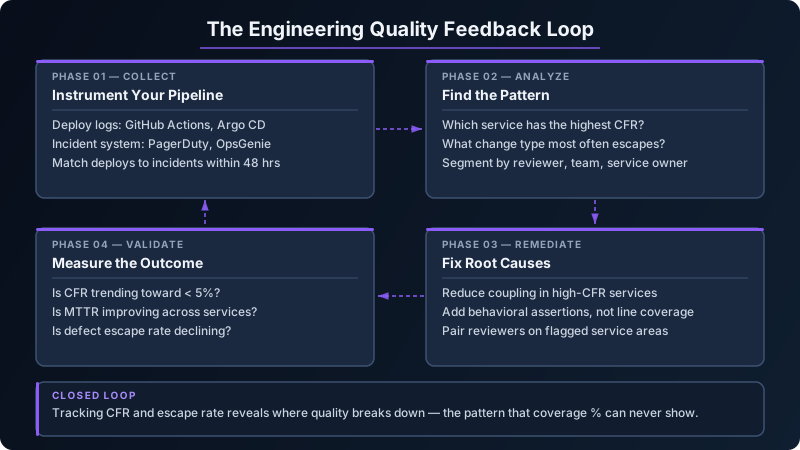
CFR can be instrumented with two data sources: your deployment system (GitHub Actions, Spinnaker, Argo CD) records when a deployment happens, and your incident system (PagerDuty, OpsGenie) records when something goes wrong. Match deployment timestamps against incident creation timestamps. Rollbacks within 48 hours of a specific commit are your failures.
Most teams undercount CFR because they only track explicit rollbacks. Silent hotfixes — a quick config change, a feature flag flip, a database update that "fixed" a broken deployment — should count too.
Mean Time to Recovery (MTTR)
MTTR measures how quickly your team restores service after a failure. Elite performers recover within an hour. Low performers can take a week or more.
MTTR matters for quality measurement because it's a leading indicator of system complexity and operational readiness. Teams with high MTTR have deployed systems they don't fully understand. They lack runbooks, automated rollback, or clear ownership. These same teams tend to have high defect escape rates — the system complexity that makes recovery slow is the same complexity that lets bugs slip through.
Track MTTR from incident created to incident resolved, segmented by service owner. Services with consistently high MTTR relative to peers are candidates for complexity reduction, not just better testing.
Defect Escape Rate
Defect escape rate is the ratio of bugs caught in production versus pre-production. A team catching 95% of defects before production has fundamentally different quality practices than a team where 40% of bugs reach users.
The challenge is attribution: you need both a pre-production bug tracker (Jira, Linear tickets marked as bugs found in review or QA) and a production incident system, then classify which environment surfaced each defect. This requires discipline in how your team logs bugs, but the signal it generates is worth the investment.
Teams that track defect escape rate tend to treat it as a system metric. When escape rate climbs, they investigate the category of defects getting through — are they always in the same service? Same type of change? The pattern reveals where your quality process breaks down, which coverage percentage never can.
Review Depth Score
Review depth is the substantive quality of code review, not just whether a review happened. It's measured through comments per changed file, the time reviewers spent before approving, and whether review comments led to code changes before merge.
A pull request approved with zero comments in 45 seconds on 400 changed lines is not a review. It's a rubber stamp. Your CI gate passed, your branch protection triggered, and you have no real signal about whether a human understood what changed.
Review depth matters because it's a leading indicator. Low depth now predicts higher CFR and defect escape rate over the next 30 days. High depth — reviewers who ask questions, request changes, and understand the system — consistently predicts lower incident rates.
GitHub's API exposes review comment count, approval timing, and whether changes were requested. The calculation is straightforward; the challenge is operationalizing it into a metric teams see regularly rather than an ad-hoc audit.
Git History as a Quality Signal
Your version control history contains quality signals that test coverage completely ignores.
PR Size Distribution. Review quality degrades sharply beyond 200–400 changed lines. Reviewers lose context, miss cross-file implications, and approve to unblock velocity rather than because they understood the change. PRs over 400 lines show a 2.5x higher defect rate compared to PRs under 150 lines.
Track the distribution of PR sizes over time, not just the mean. The mean is stable even when you have occasional 2,000-line PRs destroying review quality. The 90th percentile tells you whether your worst PRs are getting better or worse.
Bus Factor by Module. Measure what percentage of commits to each module in the last 90 days come from a single author. When one person owns more than 70% of commits to a critical service, you have a single point of failure for both production incidents (they're on call) and knowledge (they quit). Coverage can be high; the system can still be brittle because only one person knows how it actually works.
Rework Rate. Rework rate measures what percentage of lines modified in a given week were also modified in the prior two weeks. Rates above 15% signal that your team is shipping code before it's ready — the first version is landing in production, and the rework is the actual implementation.
High rework rate often correlates with external deadline pressure. The code shipped, it didn't break immediately (coverage was high), but it wasn't right, and engineers are quietly patching it in the background. That invisible technical debt never shows up in test coverage reports.
90-Day Implementation Roadmap
Quality metrics are only valuable if they're instrumented automatically and visible consistently. Here's a phased rollout that doesn't require significant tooling investment upfront.
Weeks 1–2: Instrument CFR and MTTR. Connect your deployment pipeline to your incident system. Every deployment creates a record; incidents that open within 48 hours of a deployment create a linkage. Automate this as a daily job that writes to a shared dashboard. Even a basic spreadsheet with formulas works at the start — the discipline of checking it weekly matters more than the sophistication of the tool.
Weeks 3–4: Track Review Depth. Pull GitHub API data weekly: review comment count per PR, time-to-approval, and whether any reviews requested changes. Calculate a composite score per team (not per individual). Share the distribution in your engineering all-hands.
Weeks 5–8: Calculate Rework Rate and PR Size Distribution. Git blame gives you line authorship timestamps. Compare this week's changes against a two-week lookback window. PR size distribution is directly available from GitHub's PR diff API.
Weeks 9–12: First Scorecard Retrospective. Bring the three months of data into your next quarterly engineering review. Identify the bottom two services by CFR, the bottom two by review depth, and the top two by rework rate. These are your targets. Set specific improvement goals — "reduce CFR below 8% for payments service by end of Q3" is actionable; "improve quality" is not.
A suggested metric weighting for a composite quality score: CFR (30%), defect escape rate (25%), review depth (20%), rework rate (15%), PR size distribution (10%). Adjust weights based on your organization's biggest pain points.
The Organizational Shift
Moving from coverage-centric to outcome-centric quality metrics requires changing what leadership celebrates. When you ship a release that decreases test coverage from 87% to 83% but reduces CFR from 18% to 6%, that's a quality improvement. If your org doesn't know how to read that signal, the engineer who made it will feel like they did something wrong.
The teams that make this transition successfully start by adding the outcome metrics alongside coverage, not replacing it immediately. Run both for one quarter. In every quality discussion, point to both. The pattern becomes undeniable: coverage fluctuates without correlation to incidents; CFR and rework rate track exactly with the problems engineers actually experience.
One engineering org we worked with made this shift after a 60% reduction in P1 incidents — driven not by increasing test coverage (which actually dipped slightly) but by implementing PR size limits, requiring review comments before merge on services over 50k lines, and tracking CFR weekly. Coverage was a trailing indicator that looked fine while the real problems were happening. The DORA-derived metrics caught the problems before they became outages.
---
[1] DORA State of DevOps 2023 — elite vs. low performer benchmarks for CFR and MTTR
[2] Peng, et al. (2023). "The Impact of AI on Developer Productivity" — GitHub Copilot controlled experiment
[3] CodeRabbit analysis of 470 OSS PRs — AI-generated vs. human-authored defect rates
[4] LinearB 2024 Engineering Benchmarks — PR pickup time and review cycle data